
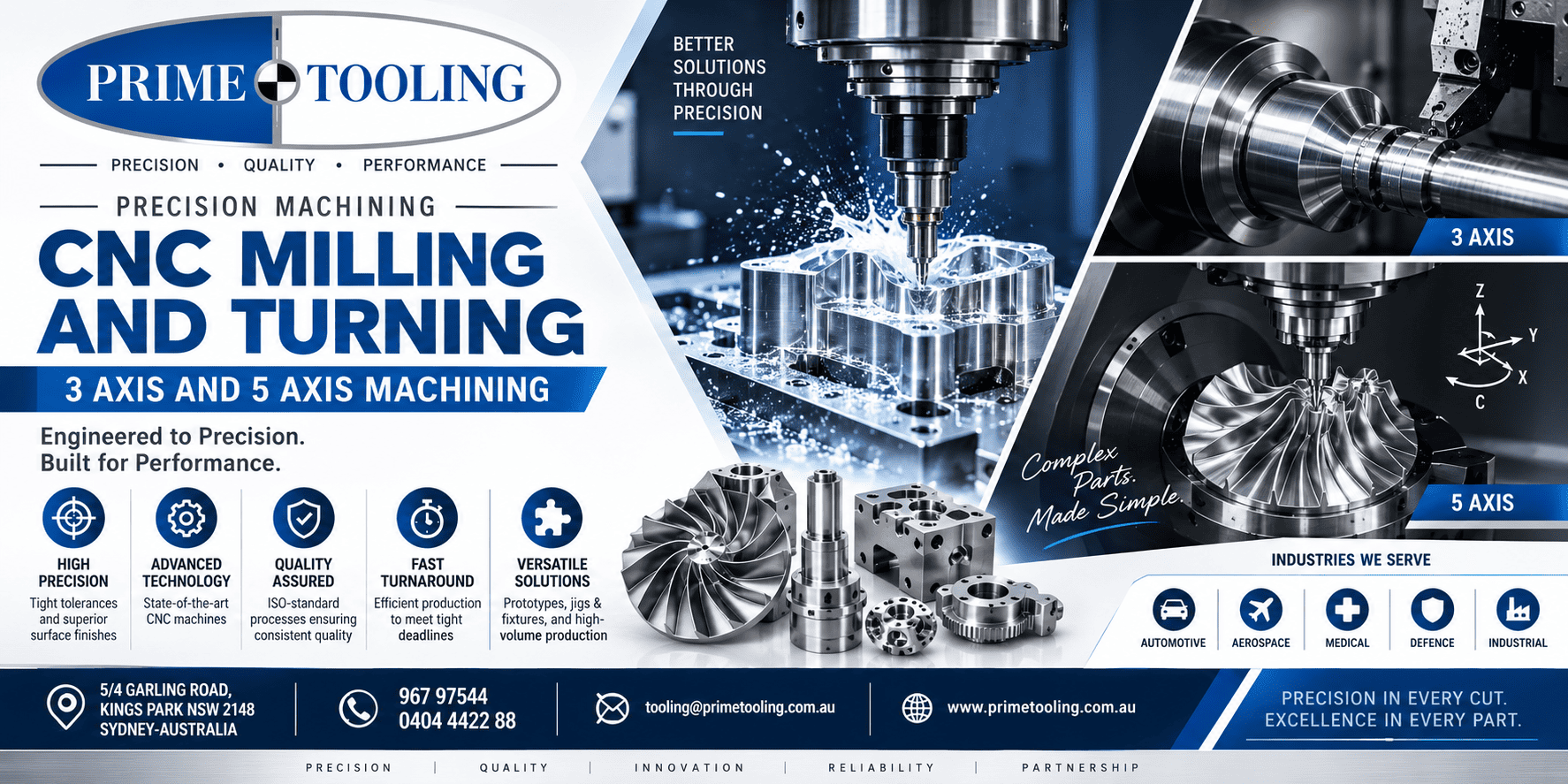
Precision Machining: CNC Milling and Turning with 3-Axis and 5-Axis Machining
Precision machining is essential for industries that require accurate, repeatable, and high-quality engineering components. Modern manufacturing technologies such as CNC milling and CNC turning allow manufacturers to produce complex parts with tight tolerances while maintaining consistency across production runs. At Prime Tooling, advanced machining capabilities support the production of precision components for a wide range of engineering and manufacturing applications.
What Is Precision Machining?
Precision machining is a manufacturing process used to remove material from a workpiece to create components with specific dimensions, shapes, and surface finishes. Computer Numerical Control (CNC) technology allows machining equipment to follow highly accurate programmed instructions, reducing human error and improving repeatability.
Precision machining can be used with materials such as aluminium, steel, stainless steel, engineering plastics, and other suitable materials. Depending on the component design, manufacturers can select CNC milling, CNC turning, or a combination of machining processes.
CNC Milling for Complex Components
CNC milling uses rotating cutting tools to remove material from a stationary workpiece. It is suitable for producing slots, pockets, holes, contours, faces, and other detailed features.
Modern CNC milling machines provide excellent control over cutting operations and can manufacture components according to detailed CAD designs. This makes CNC milling particularly useful for tooling, prototypes, engineering components, fixtures, and production parts.
For manufacturers looking for precision machining CNC milling, selecting an experienced machining partner is important. Accurate programming, appropriate tooling, machine setup, and quality inspection all contribute to achieving the required component specifications.
CNC Turning for Cylindrical Parts
CNC turning is another important precision machining process. During turning, the workpiece rotates while a cutting tool removes material to create the required diameter, profile, groove, thread, or other feature.
CNC turning is commonly used for shafts, pins, bushes, sleeves, fittings, and other round or cylindrical components. The automated process allows manufacturers to maintain consistent dimensions across multiple parts while improving production efficiency.
Combining CNC turning with milling capabilities can also provide greater flexibility when components require multiple machining operations.
3-Axis CNC Machining
3-axis machining is one of the most widely used CNC machining methods. The cutting tool moves along three primary axes—X, Y, and Z—to machine different features of a component.
Three-axis CNC machining is highly effective for many standard engineering parts, including flat surfaces, pockets, holes, slots, and relatively straightforward 3D profiles. It can provide an economical solution for components that do not require simultaneous multi-axis cutting.
The success of a 3-axis machining project depends on accurate programming, appropriate workholding, cutting-tool selection, and careful quality control.
5-Axis CNC Machining
For more complex components, 5-axis machining provides additional movement and flexibility. A 5-axis machine can position the cutting tool and workpiece at multiple angles, allowing complex geometries to be machined with fewer setups.
This capability can reduce the need for repeated repositioning of a component and can improve access to difficult-to-reach surfaces. It is particularly valuable for intricate engineering components, complex mould components, prototypes, and parts with angled or curved features.
Compared with conventional machining approaches, 5-axis machining can help improve accuracy, reduce setup time, and achieve sophisticated component geometries when the application requires it.
3-Axis vs 5-Axis Machining: Which Is Better?
The right machining method depends on the design and requirements of the component.
3-axis machining can be an excellent choice for components with relatively simple geometries and accessible machining surfaces. It can offer an efficient and cost-effective approach for many engineering applications.
5-axis machining becomes more advantageous when a component contains complex contours, multiple angled surfaces, deep features, or difficult-to-access areas. By machining several surfaces from different angles, the process can reduce setups and improve consistency.
An experienced machining provider can assess the component design and recommend the most suitable manufacturing approach based on accuracy, complexity, material, quantity, and production requirements.
Importance of Accuracy and Quality Control
Precision machining is not only about removing material; it is also about producing components that consistently meet design specifications. Quality control is therefore an important part of the machining process.
Inspection procedures can help verify dimensions, tolerances, surface quality, and other component requirements. Combining modern CNC equipment with experienced operators and suitable inspection methods helps manufacturers achieve reliable results.
Applications of Precision CNC Machining
Precision CNC milling and turning are used across many industries and applications, including:
- Engineering components
- Tooling and mould components
- Jigs and fixtures
- Prototypes and development parts
- Machinery components
- Automotive components
- Industrial equipment
- Custom replacement parts
- Complex manufactured components
The flexibility of CNC technology makes it suitable for both prototype development and repeat production requirements.
Choose Prime Tooling for Precision Machining
When component accuracy, repeatability, and manufacturing quality matter, working with an experienced machining company can make a significant difference. Prime Tooling provides engineering and manufacturing solutions designed around the specific requirements of each project.
From CNC milling and turning to 3-axis and 5-axis machining, modern precision machining techniques can help transform detailed designs into accurate, functional components. Whether you require a prototype, tooling component, custom engineering part, or production machining, selecting the right process and manufacturing expertise is essential.
For businesses seeking dependable precision machining, CNC milling and turning, and 3-axis and 5-axis machining, Prime Tooling can provide professional manufacturing support tailored to project requirements.
Visit Prime Tooling to learn more about its precision engineering and machining capabilities.

Leave a Reply